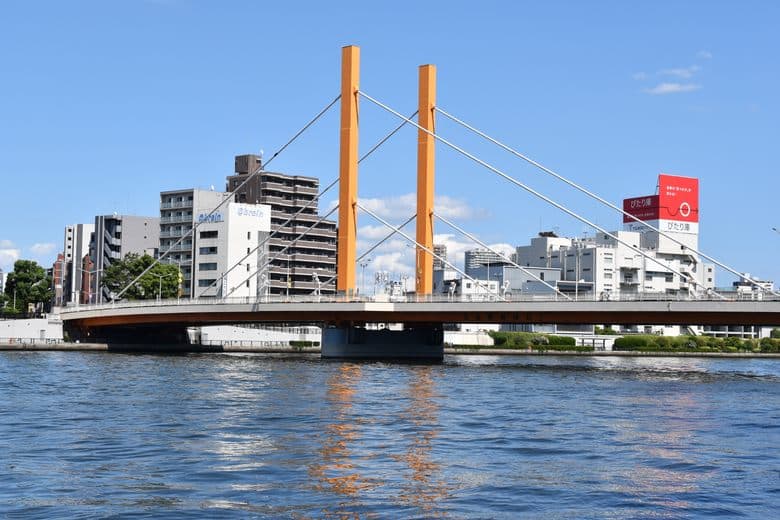
The Shin-Ōhashi Bridge, connecting the Chūō and Kōtō wards over the Sumida River, is more than just a modern crossing; it's a site steeped in history and art. Its predecessor was famously depicted in Utagawa Hiroshige's 1856 woodblock print, 'Sudden Shower over Shin-Ōhashi Bridge and Atake,' a masterpiece that profoundly influenced European Impressionists, including Vincent Van Gogh. While the original bridge no longer stands, the current structure, completed in 1977, carries forward a legacy that dates back to 1693, having been rebuilt numerous times after fires, storms, and floods.
Visitors often appreciate the bridge for its bright yellow pillars and its role in the city's infrastructure, though many are unaware of its deep artistic roots. The area around the bridge offers pleasant views of the Sumida River, and some visitors enjoy walking across to take in the urban landscape. However, those expecting a direct visual link to Hiroshige's print or Van Gogh's painting might find the modern bridge less evocative of that specific historical period.
For those interested in its artistic connection, it's advisable to research Hiroshige's print beforehand to fully appreciate the historical context. A visit typically involves a brief walk across the bridge, perhaps 15-30 minutes, to observe the river and surrounding areas. There are no specific items to bring, but a camera might be useful for capturing the contemporary views. The best time to visit would be during daylight hours for clear views, or in the evening to see the city lights reflecting on the water.
The Shin-Ōhashi Bridge is easily accessible via public transport. The nearest subway stations are Hamacho Station (Toei Shinjuku Line) and Morishita Station (Toei Shinjuku Line and Toei Oedo Line), both within a short walking distance. From these stations, visitors can reach the bridge in about 5-10 minutes on foot. Driving is generally not recommended for tourists in central Tokyo due to traffic and limited parking, but if necessary, public parking lots can be found in the surrounding neighborhoods.
A common complaint among visitors is the lack of obvious historical markers or information about the bridge's artistic significance on-site. To mitigate this, it is recommended to read up on its history and its connection to Hiroshige and Van Gogh before visiting. This preparation can enhance the experience, allowing visitors to appreciate the site's importance beyond its modern appearance.