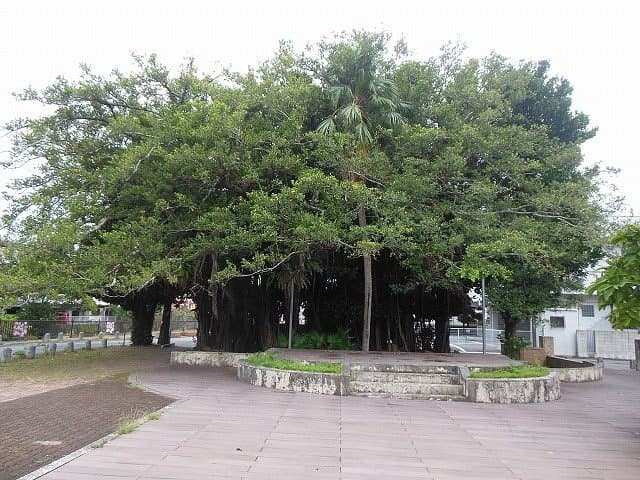
The Nago Himpun Banyan Tree, also known locally as Gajumaru, is a venerable natural monument in Nago City, Okinawa. With an estimated age exceeding 300 years, this colossal banyan has been celebrated in local Ryukyu songs since the 17th century and is considered a significant symbol of the city. Its sheer size and historical presence make it a point of local pride and a testament to Okinawa's natural heritage.
Visitors consistently describe the tree as massive and impressive, particularly noting its sprawling branches and the visible steel beams used to support its ancient structure. Many appreciate its historical significance and the fact that it's a protected national natural monument. However, a recurring theme in reviews is the tree's location: it sits prominently in the middle of a road or roundabout, which can make it difficult to approach closely or photograph without traffic interference. Some visitors find it less accessible than anticipated due to its placement.
For those planning a visit, it's recommended to view the tree from a slight distance to appreciate its full scale, rather than attempting to get too close amidst traffic. Several reviewers suggest combining a visit with other nearby attractions, such as the Nago Museum or the Orion Beer factory, which are often within a 10-minute walk. This approach turns it into a convenient, brief stop rather than a standalone destination. There is a parking lot mentioned nearby, which can be helpful for those driving.
The Nago Himpun Banyan Tree is located at 1-1 Ohigashi, Nago. Its central location on Ohigashi Street means it's easily visible whether driving or walking through the area. For those relying on public transport, it's advisable to check local bus routes serving the Nago city center. Its proximity to the Nago Museum and Orion Beer factory suggests it's well within the walkable core of the city, making it accessible on foot if you are already in the vicinity of these other attractions.
The primary complaint revolves around its location in the middle of a road, making it challenging to get good photos or a close-up view. To mitigate this, consider visiting during off-peak traffic hours if possible, or simply appreciate it from a safe distance on the sidewalk. Remember that as a national natural monument, climbing the tree is prohibited.