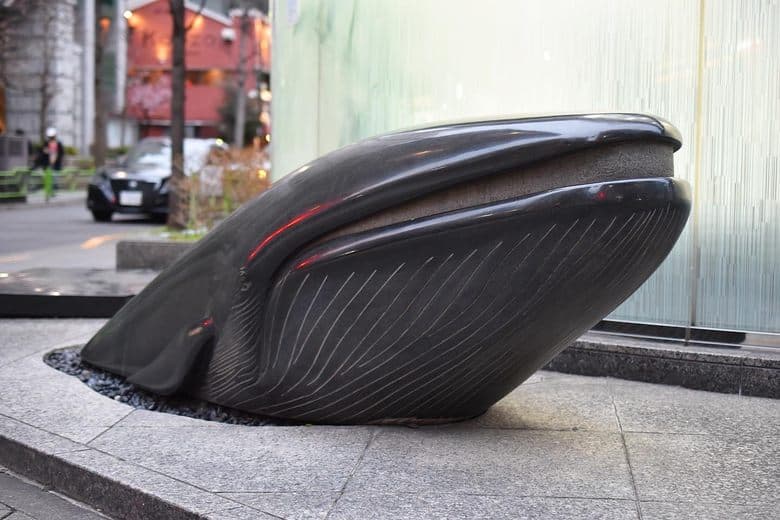
The Whale Monument, located in Tokyo's historic Ningyōchō district, is a distinctive public art piece that pays homage to the area's rich theatrical past. This sculpture, depicting a whale seemingly swimming through the urban landscape, serves as a subtle yet significant reminder of the role baleen played in the intricate art of bunraku puppetry. Ningyōchō, meaning "Doll Town," was historically a hub for kabuki and bunraku, and this monument connects the district's heritage with a unique aspect of traditional craftsmanship.
Visitors often appreciate the monument's unexpected presence and its artistic quality. Reviewers find it to be a charming and thought-provoking piece, especially for those interested in the lesser-known facets of Japanese culture and history. The sculpture's lifelike appearance and the intriguing story behind its creation are frequently highlighted as positive aspects. However, some note that its location on a side street amidst office buildings makes it easy to miss if one isn't specifically looking for it.
To fully appreciate the monument, visitors should allow for a brief stop, perhaps 10-15 minutes, to observe the sculpture and read any accompanying information (though none is explicitly mentioned in reviews, it's good practice to look). It's best visited during daylight hours for clear viewing. There are no specific items to bring, but a camera is recommended for those who wish to capture its unique design. As it's a free, outdoor installation, there are no entry fees or strict opening hours.
The Whale Monument is situated in the Ningyōchō district, which is well-served by public transportation. The nearest station is Ningyōchō Station, accessible via the Tokyo Metro Hibiya Line and the Toei Asakusa Line. From the station, the monument is typically a short walk of about 5-10 minutes. Reviewers suggest combining a visit here with exploring other historical sites and traditional shops in the Ningyōchō area, making it part of a broader walking tour of the district rather than a standalone destination.
A common complaint, or rather an observation, is that the monument can be easily overlooked due to its unassuming location. To mitigate this, visitors should use a map or GPS to pinpoint its exact spot on a side street. It's not a grand, imposing landmark, but rather a subtle piece of urban art that rewards those who seek it out with a unique cultural insight.