The Site of Yatate Hajime is a historical and literary landmark in Tokyo, commemorating the departure point of Matsuo Bashō, one of Japan's most celebrated haiku poets, on his epic journey documented in "The Narrow Road to the Deep North." This location is significant as it marks where Bashō composed his poignant inaugural haiku, symbolizing "the beginning of writing" (yatate hajime) for his travels.
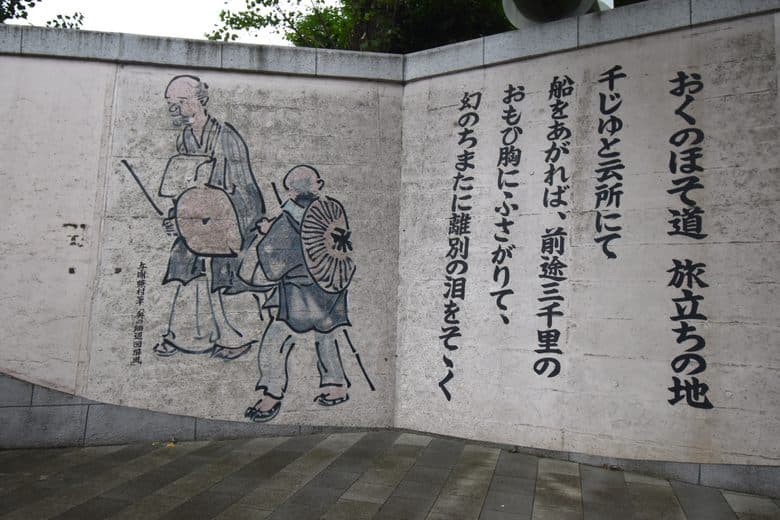
Visitors primarily come here for its historical and literary resonance. The main attractions include a mural depicting Bashō's famous haiku, "Spring passing; the birds cry out and the eyes of the fish are filled with tears," located under the Senju-ōhashi Bridge. Additionally, statues of Bashō are situated on both banks of the Sumida River, reflecting the historical uncertainty of his exact disembarkation point. The Senju-ōhashi Bridge itself holds historical value, being a rare example of a long-standing wooden bridge from the Edo period, rebuilt multiple times after natural disasters.
To fully appreciate the site, visitors should allow about 30-60 minutes for exploration, including time to read the commemorative plaques and observe the bridge and river. There are no specific items to bring, but a camera might be useful for capturing the mural and statues. The best time to visit is during daylight hours to clearly see the mural and statues. This site is more about quiet contemplation than active engagement, so it's suitable for those seeking a deeper connection with Japanese literary heritage.
The site is conveniently accessible by public transport. The Senju-ōhashi Bridge is within a five-minute walk from Senju-ōhashi Station. For those wishing to see both Bashō statues, the north side statue is across the road from the bridge, while the south side statue is located in front of Minami-Senju Station, approximately a 10-minute walk from the bridge. This makes it easy to reach via local train lines.
There are no common complaints associated with this site, as it is a relatively straightforward historical marker. Visitors should simply manage their expectations, understanding that it is a commemorative site rather than a large-scale attraction, offering a glimpse into Japan's rich poetic past.