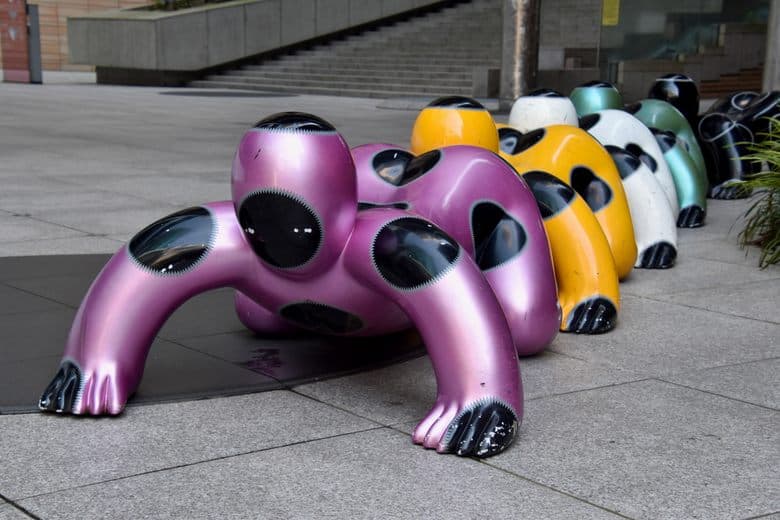
Shiotama refers to a series of distinctive, polka-dotted humanoid sculptures situated in the NTV plaza at the base of the Nittele Tower in Tokyo's Shiodome district. These somewhat surreal figures, designed as mascots for Nippon TV, depict creatures crawling on all fours with their bottoms raised, creating a rather bizarre and memorable scene. They were introduced in 2003 when Nittele relocated its headquarters, intended to be a new brand identity, and remain a permanent fixture in the plaza.
Visitors often encounter Shiotama unexpectedly while en route to more famous nearby attractions, such as the Ghibli Clock. Reviewers consistently describe the sculptures as 'bizarre,' 'quirky,' and 'unusual,' noting their metallic colors and polka-dot patterns. While not a standalone destination, many find them to be an amusing and unique photo opportunity, adding an unexpected artistic touch to the urban landscape. Some visitors also appreciate that the sculptures double as benches, offering a functional aspect to their peculiar design.
There's no specific time commitment required for Shiotama; it's best experienced as a brief stop. Visitors typically spend only a few minutes observing and photographing the sculptures. There are no entry fees or specific opening hours, as they are located in an open public plaza. It's recommended to visit during daylight hours for better visibility and photography, though they might offer a different, perhaps more eerie, ambiance at night.
The Shiotama sculptures are conveniently located in the Shiodome district, which is well-served by public transportation. The nearest major station is Shiodome Station, accessible via the Toei Oedo Line and the Yurikamome Line. Alternatively, Shimbashi Station, a larger hub with JR lines (Yamanote, Keihin-Tohoku, Tokaido) and Tokyo Metro Ginza Line, is also within easy walking distance, typically less than 10 minutes. From either station, follow signs towards the Nittele Tower or the NTV plaza. Driving is generally not recommended in central Tokyo due to traffic and limited parking, but if necessary, paid parking garages are available in the vicinity.
Common complaints are rare, as the sculptures are a free, open-air installation. However, some visitors might find their aesthetic unsettling or simply not to their taste. Since they are not a primary attraction, managing expectations and viewing them as a brief, curious diversion rather than a major highlight can help mitigate any potential disappointment. They are best appreciated as a quirky piece of public art rather than a grand monument.