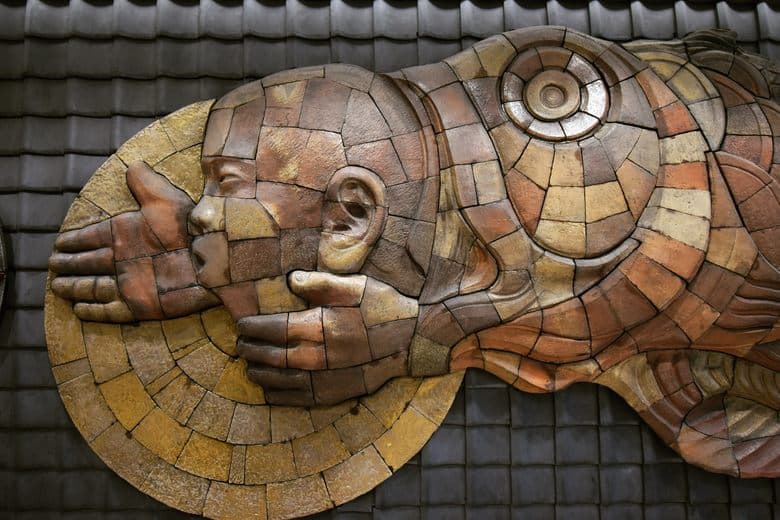
The "Fugetsu En'nen" mural, meaning "Revelrous Dance of Wind and Moon," is a significant public art piece by Japanese-Mexican artist Luis Nishizawa. Located within Keisei Ueno Station, it serves as a thought-provoking visual narrative, deeply rooted in Japanese tradition and mythology. The artwork features a young boy emerging from the mouth of a koi fish, reaching for a colorful pinwheel, symbolizing Children's Day, the struggle against adversity, and the promise of the future.
Visitors often find the mural's intricate symbolism and vibrant imagery to be a refreshing contrast to the bustling station environment. Many appreciate its artistic depth and the way it subtly educates about Japanese cultural practices, such as the koinobori (carp-shaped windsocks) flown during Children's Day. The artwork encourages contemplation, with some reviewers noting how it prompts discussions about its meaning and artistic intent.
To fully appreciate the mural, visitors should allocate about 5-10 minutes. It's best viewed during off-peak hours to avoid the station's busiest periods, allowing for a more unhurried observation. There are no specific items to bring, but a camera might be useful for capturing its details. Since it's located within a public transport hub, there are no entry fees or special access requirements.
The mural is specifically located at Keisei Ueno Station. It is crucial to note that this is distinct from the JR Ueno Station or Tokyo Metro Ueno Station. Travelers using public transport should ensure they are heading to the Keisei line. The mural is typically found near the entrance/exit areas of the station, making it easily accessible for those passing through or arriving/departing from Keisei Ueno.
A common complaint, though minor, is that the mural can be easily overlooked amidst the station's activity. To mitigate this, visitors are advised to actively look for it upon entering or exiting Keisei Ueno Station, perhaps by asking station staff for directions if needed.