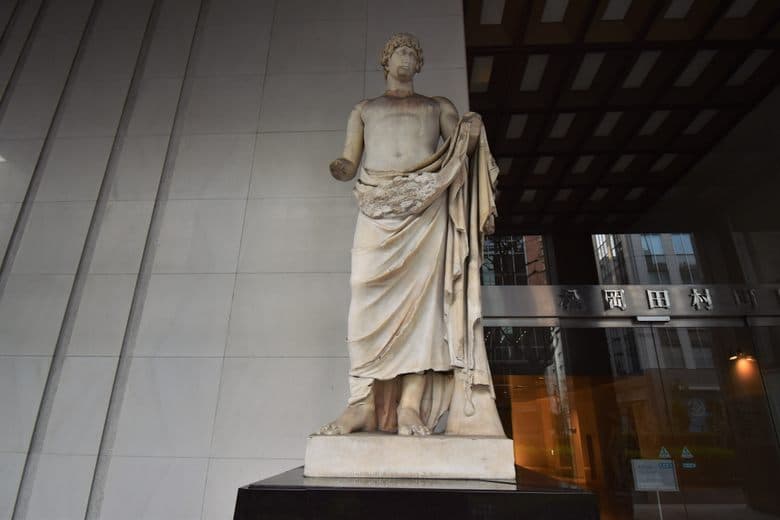
The 'Antinous as Vertumnus' statue is a genuine 2nd-century Roman marble sculpture, depicting Antinous, the beloved of Emperor Hadrian, dressed as the Roman god of seasons and change. It stands unexpectedly outside the Matsuoka Tamurachō Building in Tokyo's Shinbashi district, a curious remnant of a former private art museum. Its presence offers a unique juxtaposition of ancient history against a modern urban backdrop, making it a point of interest for those seeking the unusual.
Visitors consistently express surprise and delight at discovering such an authentic piece of Roman antiquity in Tokyo. Many note the melancholic expression on Antinous's face and the subtle signs of centuries of wear on the marble, which distinguish it from a modern replica. The quiet, unassuming location is often praised, allowing for a moment of reflection away from the city's usual tourist crowds. Reviewers appreciate the opportunity to observe a piece of history that is freely accessible and not behind museum glass.
To fully appreciate the statue, visitors recommend taking a moment to step closer and examine the details, rather than simply walking past. While there isn't much to 'do' beyond observing the statue, the experience is enhanced by knowing its historical context. There are also a few other ancient Roman sculptures visible inside the building's lobby, which can be viewed through the glass. No special equipment is needed, and a visit typically lasts only 10-15 minutes. The best time to visit is during daylight hours for optimal viewing, though its outdoor location means it's always accessible.
The statue is conveniently located and easily accessible by public transport. The nearest station is Onarimon Station, from which it is only a 3-minute walk. Alternatively, it can be reached from Shimbashi Station (spelled with an 'M'), which is about a 10-minute walk away. Both stations are well-connected to Tokyo's extensive train network. As it's an outdoor, publicly accessible statue, no specific entrance or parking information is required.
The main 'complaint' or potential disappointment for some visitors is its small scale and the fact that it's just one statue outside an office building, which might not meet expectations for those anticipating a larger exhibition. To mitigate this, approach the visit with the understanding that it's a brief, contemplative encounter with a single, historically significant artifact, rather than a major attraction.