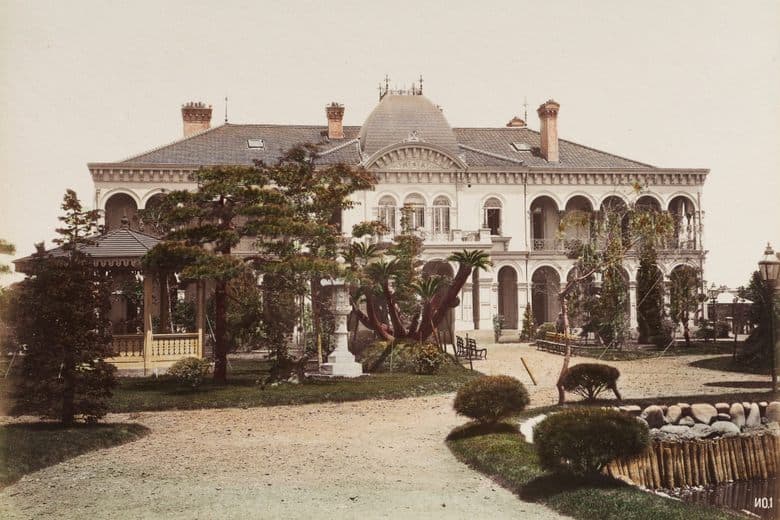
The Site of the Rokumeikan is a historical marker in Tokyo, commemorating the location of a grand state guest house built in 1883. Commissioned by Marquess Inoue Kaoru and designed by British architect Josiah Conder, the Rokumeikan was intended to showcase Japan's modernization and openness to the West during the Meiji era. It became famous for its elaborate French-style parties and banquets, though its actual influence and success in diplomatic goals were often exaggerated. The building was eventually demolished in 1940, leaving behind only a few preserved artifacts in other locations.
Visitors consistently note that there is very little to see at the site itself. The main attraction is an inconspicuous plaque, often overlooked amidst the bustling urban environment. Reviewers emphasize that this is not a visual spectacle or a major tourist destination, but rather a spot for those with a specific interest in Japanese history, particularly the Meiji Restoration and its cultural shifts. There are no remaining structures or ruins to explore, making it a purely intellectual or contemplative visit.
For those interested in visiting, it is crucial to manage expectations. Do not anticipate a grand monument or a museum. Instead, prepare for a brief stop to acknowledge a historical location. There are no specific items to bring, and the visit itself will likely take only a few minutes. It is best combined with other activities in the surrounding area, as it does not warrant a dedicated trip. There are no entry fees or specific opening hours, as it is an outdoor plaque.
The site is located in a busy part of Tokyo. While specific public transport lines are not mentioned in reviews, Tokyo's excellent public transportation system means it is accessible by subway or train to a nearby station, followed by a short walk. Driving is generally not recommended in central Tokyo due to traffic and limited parking. Visitors should consult a map application for the most direct route from their current location to the plaque.
A common complaint is the lack of visual interest and the difficulty in finding the plaque due to its unassuming nature. To mitigate this, visitors should use precise GPS coordinates or a detailed map to locate the exact spot. It is easy to walk past without noticing it, so deliberate searching is required. Understanding its historical context beforehand will enhance the appreciation of this subtle landmark.