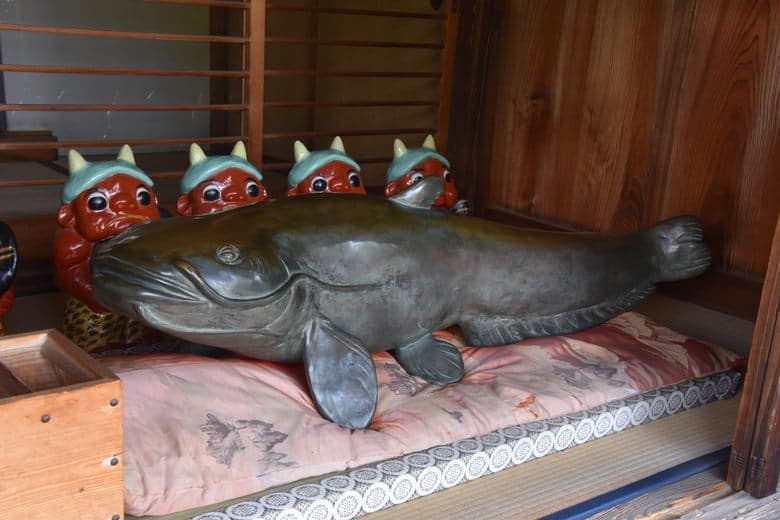
Namazu-San, the Lucky Catfish, is an intriguing and somewhat quirky attraction located within the historical Raiden Shrine in Itakura, Gunma. While Raiden Shrine itself dates back to 598 CE and is a significant center for thunder worship, Namazu-San offers a unique cultural experience tied to Japanese folklore and wordplay. This sleek brass catfish sculpture, accompanied by red demon guardians, represents the mythical subterrestrial catfish believed to cause earthquakes. However, due to a homophonic connection between the Japanese words for 'earthquake' (jishin) and 'confidence' (jishin), Namazu-San has also become a deity associated with boosting self-assurance.
Visitors consistently find the concept behind Namazu-San fascinating and the ritual of wiping the statue to be a memorable, if unusual, experience. Many appreciate the cultural insight into Japanese folklore and the clever linguistic twist that gives the catfish its dual significance. The unattended nature of the annex allows for a quiet, reflective visit, and the opportunity to take home a small piece of 'luck' or 'confidence' is often highlighted as a charming aspect.
To fully appreciate Namazu-San, visitors should allocate about 30 minutes to an hour. This allows time to read the available information (if any in English), observe the sculpture, and participate in the wiping ritual. It's advisable to bring a 300 yen coin for the donation to receive a handkerchief. The best time to visit would likely be during daylight hours, as the annex might be less accessible or lit after dark. Since it's an annex, it's generally a quick stop rather than a full-day excursion.
Raiden Shrine is located in Itakura, Gunma. While specific public transport details are not readily available in reviews, visitors to rural shrines in Japan often rely on local bus services from the nearest train station or personal vehicles. Itakura-machi Station (板倉東洋大前駅) on the Tobu Nikko Line is likely the closest major train station. From there, local buses or a taxi would be necessary to reach the shrine. Driving offers more flexibility, and parking is typically available at larger shrines. It's recommended to check local bus schedules or taxi availability in advance if relying on public transport.
One potential complaint could be the lack of extensive English signage or information, which might make the full context of Namazu-San less accessible to non-Japanese speakers without prior research. To mitigate this, it is highly recommended to read up on the folklore of Namazu and the 'jishin' wordplay before your visit. Some visitors might also find the experience brief if they are not deeply engaged with the cultural significance, so managing expectations for a short, unique cultural interaction rather than a grand spectacle is key.