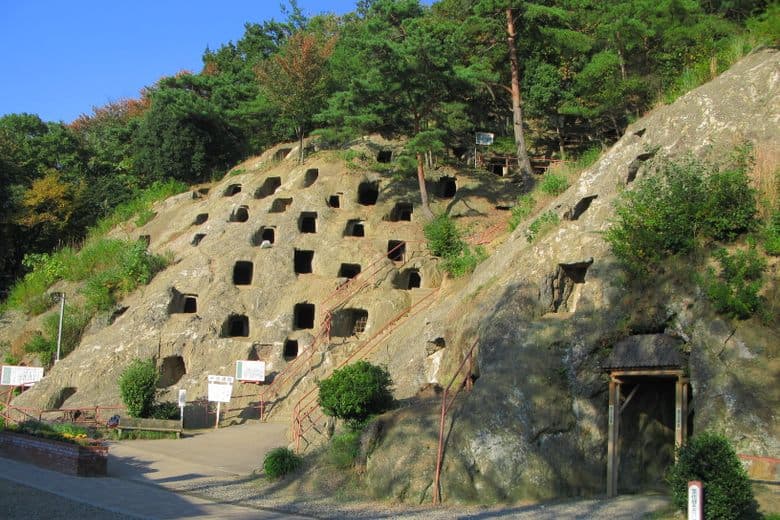
The Gankutsu Hotel, despite its misleading name, was never intended to be a hotel. It is a fascinating, albeit unfinished, architectural project carved into a sandstone cliff by a local strawberry farmer, Minekichi Takahashi, between 1904 and 1925. Originally conceived as a sake brewery and cellar, this unique structure gained significant local fame and even international recognition in its heyday. Its historical significance is further deepened by its use as a military factory during World War II, connecting it to the Yoshimi Hundred Caves and Matsuyama Castle.
Visitors consistently note that the site is now closed to the public and can only be viewed from behind fences. This means the experience is primarily one of observation rather than exploration. Reviewers often express a sense of intrigue about its past and the sheer effort involved in its creation. The site attracts those interested in 'haikyo' (urban exploration of ruins) and local history, offering a glimpse into a peculiar chapter of Japanese ingenuity.
For those planning a visit, it's crucial to understand that direct access is prohibited. Allocate a brief amount of time, perhaps 15-30 minutes, primarily for viewing and photography from the designated perimeter. There are no facilities or services available at the site itself. It is best visited during daylight hours for clear visibility. Consider combining this visit with the Yoshimi Hundred Caves, which are a short distance away, to make the most of your trip to the area.
To reach Gankutsu Hotel, the nearest train station is Higashi-matsuyama. From there, the nearest bus stop is Hyakuana-iriguchi. The site is not directly accessible by car to its immediate vicinity due to its fenced-off nature, and parking information is not readily available for direct access. Public transport is the recommended way to get close, followed by a walk to the viewing area.
The primary complaint is the lack of public access. To mitigate this, manage expectations by understanding that it is a viewing-only experience. Focus on appreciating the historical context and the unique visual aspect of the carved cliff from a distance, rather than expecting to enter or explore the structure.