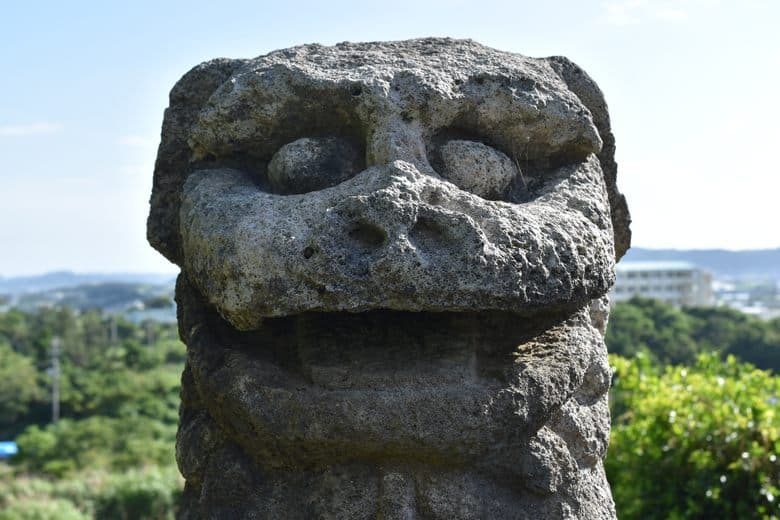
The Tomori Stone Lion is a historically significant guardian statue, known as a shisa, located in Yaese, Okinawa. Believed to be the oldest and largest village shisa on the island, it dates back to 1689. Its creation was advised by a feng shui diviner to protect the village of Tomori from frequent fires, facing Mount Yaese, then known as Fire Mountain. This statue is not just a local landmark but also a symbol of Okinawan culture, inspiring countless other shisa across the island.
Visitors are often struck by the lion's resilience, particularly its survival during the Battle of Okinawa in World War II. Photographs from 1945 show American soldiers using it as a shield, and bullet holes are still visible on its surface today. This tangible link to a pivotal historical event is a major draw for those interested in war history and local heritage. However, some visitors note that the lion itself is relatively small and might not be as visually imposing as expected, especially for those unfamiliar with the cultural significance of shisa.
To fully appreciate the Tomori Stone Lion, it is recommended to spend about 30 minutes to an hour. This allows time to read any informational plaques, observe the details of the statue, and reflect on its historical context. The best time to visit is during daylight hours, as the site is open-air and offers no artificial lighting. There are no facilities or shops directly at the site, so it's advisable to bring your own water, especially during warmer months. Since it's a historical site, respectful behavior is encouraged. There are no entry fees, making it an accessible historical stop.
The Tomori Stone Lion is located in the Yaese area. While specific public transport options directly to the site are not widely detailed in visitor reviews, it is generally accessible by car. Visitors often combine a trip to the Tomori Stone Lion with other attractions in the southern part of Okinawa. Parking is typically available nearby, though it might be informal street parking in a residential area. Using a GPS or mapping application is highly recommended for navigation, as the site is nestled within a village setting.
A common complaint is that the site can be difficult to find without precise navigation, and its appearance might be underwhelming for those expecting a grand monument. To mitigate this, set clear expectations: it is a rustic, historically significant stone carving, not a large, ornate sculpture. Researching its history beforehand significantly enhances the visit, transforming it from a simple photo opportunity into a meaningful encounter with Okinawan heritage.