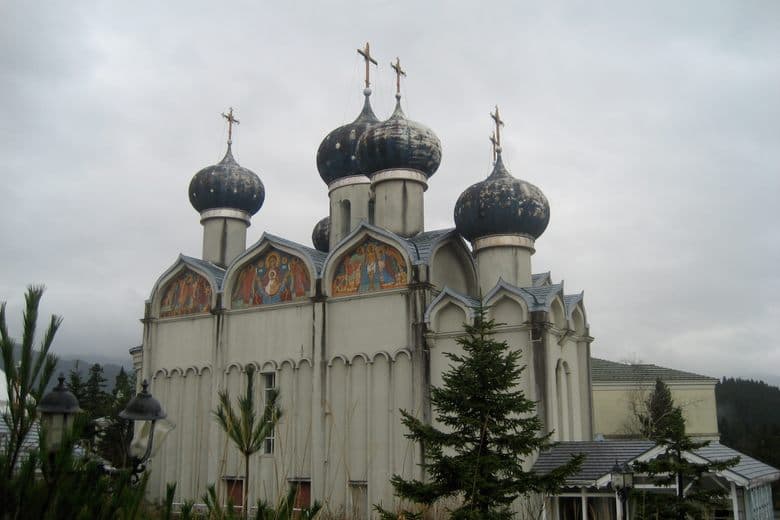
The Niigata Russian Village was an unusual theme park concept launched in 1993 with the aim of strengthening cultural ties between Japan and Russia. It featured a large cathedral, a hotel, theaters, restaurants, and even a golf course, attempting to recreate a slice of Russian culture in Japan. Despite initial ambitions, the park struggled with visitor numbers, leading to its closure and a brief reopening in 2002 before permanently shutting its doors just six months later.
For a period after its abandonment, the site became a destination for urban explorers, drawn by the eerie remnants of its past, including a fake woolly mammoth taxidermy and skeleton. However, by July 2016, the vast majority of the park's structures, including the main buildings, had been demolished. What remains today is largely an empty plot of land with minimal, if any, discernible features of the former attraction.
Given the extensive demolition, there is nothing of historical or recreational value left for a typical tourist. Visitors seeking abandoned sites or unique cultural experiences will find only disappointment, as the structures that once made it an 'amazing sight' for urban explorers are gone. There are no facilities, no services, and no safety measures in place.
The former site of the Niigata Russian Village is located off Route 290 in Suibara, near Agano. While Atlas Obscura previously mentioned looking for an old sign and walking up a hill behind a gate, this advice is now outdated due to the demolition. Public transportation to this specific, now non-existent, attraction is not practical, and driving to the location would only lead to an empty lot.
The primary complaint, or rather the reality, is that the attraction no longer exists. Any attempt to visit will result in finding a demolished site. There is no way to mitigate this, as the place itself has been removed.