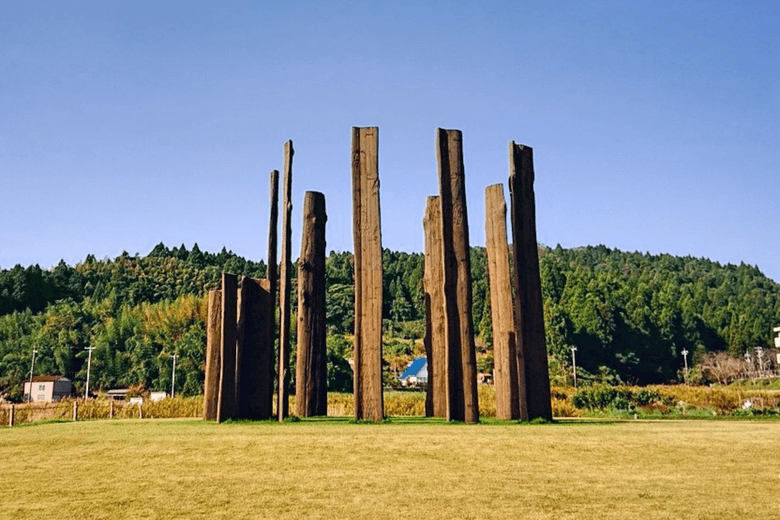
The Mawaki Site in Ishikawa Prefecture's Noto Peninsula is a significant archaeological discovery, representing a Jōmon period settlement that thrived for over 4,000 years. It provides invaluable insights into the daily lives, customs, and technological advancements of prehistoric Japanese people, making it a crucial site for understanding the region's ancient history.
Visitors consistently find the reconstructed timber circle to be a highlight, offering a tangible connection to the past. The interpretive displays detailing the Jōmon people's use of dolphin bones for tools and trade, as well as the discovery of the oldest known clay mask fragment in Japan, are often praised for their educational value. Reviewers appreciate the effort to preserve and present this ancient history, noting the peaceful and contemplative atmosphere of the site.
To make the most of a visit, it is recommended to allocate at least 1-2 hours to fully explore the site and its interpretive panels. Bringing comfortable walking shoes is advisable, as the site involves some outdoor exploration. Given its remote location, packing snacks and water might be beneficial, as amenities are limited. The site is best visited during daylight hours, and a clear day will enhance the experience of the outdoor reconstructions.
The Mawaki Site is located in Noto, Ishikawa Prefecture. Due to its remote location on the Noto Peninsula, reaching the site primarily requires private transportation. There are no direct train lines or frequent bus services that stop immediately at the site. Visitors typically drive, and parking is usually available on-site. Public transport options to the general Noto area exist, such as buses from Kanazawa, but a transfer or taxi would likely be necessary for the final leg of the journey to Mawaki Site itself.
Some visitors mention the lack of extensive English signage, which can make understanding the exhibits challenging without prior research or a guide. To mitigate this, it is recommended to read up on the Jōmon period and the Mawaki Site specifically before visiting, or to use a translation app for the Japanese descriptions.