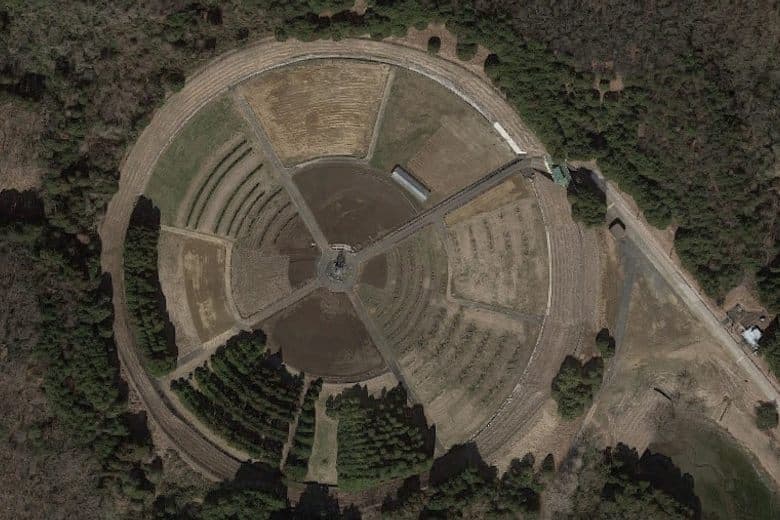
The Gamma Field, located near Hitachiōmiya-shi in Ibaraki-ken, Japan, is a unique and historically significant scientific facility. Established in 1962 by Japan's Institute of Radiation Breeding (IRB), it is the world's largest facility for radiation-induced plant breeding. Here, plants are exposed to gamma rays from a cobalt-60 source to induce genetic mutations, with the aim of developing new, improved crop varieties. This site represents a fascinating, albeit niche, aspect of agricultural science and the 'atomic vegetables' boom of the mid-20th century.
Visitor experiences are virtually non-existent as this is a highly restricted research facility. The primary purpose of the site is scientific experimentation, not public education or tourism. The facility operates Monday through Friday, with irradiation occurring from noon to 8 p.m. daily. Plants are arranged in a field, with those closest to the cobalt source receiving doses significantly higher than background radiation. A substantial wall, over 25 feet tall, surrounds the field to shield the outside environment from radiation.
Given its nature as a high-security scientific research site, there are no practical visitor tips regarding what to bring, how long to spend, or what to skip. Public access is not permitted, and there are no designated viewing areas or visitor centers. Any attempt to visit without explicit permission would be futile and potentially hazardous.
The Gamma Field is situated in a rural area, approximately two hours northeast of Tokyo. Public transport options are extremely limited, and there are no direct train or bus lines that would take a visitor to the facility. Driving would be the only feasible way to reach the general vicinity, but even then, access to the facility itself is restricted. There is no information available regarding parking for unauthorized visitors, as such a concept does not apply to a restricted research site.
The main 'complaint' or challenge for anyone interested in this site is the complete lack of public access. This is not a place for casual tourism. To mitigate this, those interested in the work conducted here should seek out published scientific papers or official IRB communications, rather than attempting a physical visit.