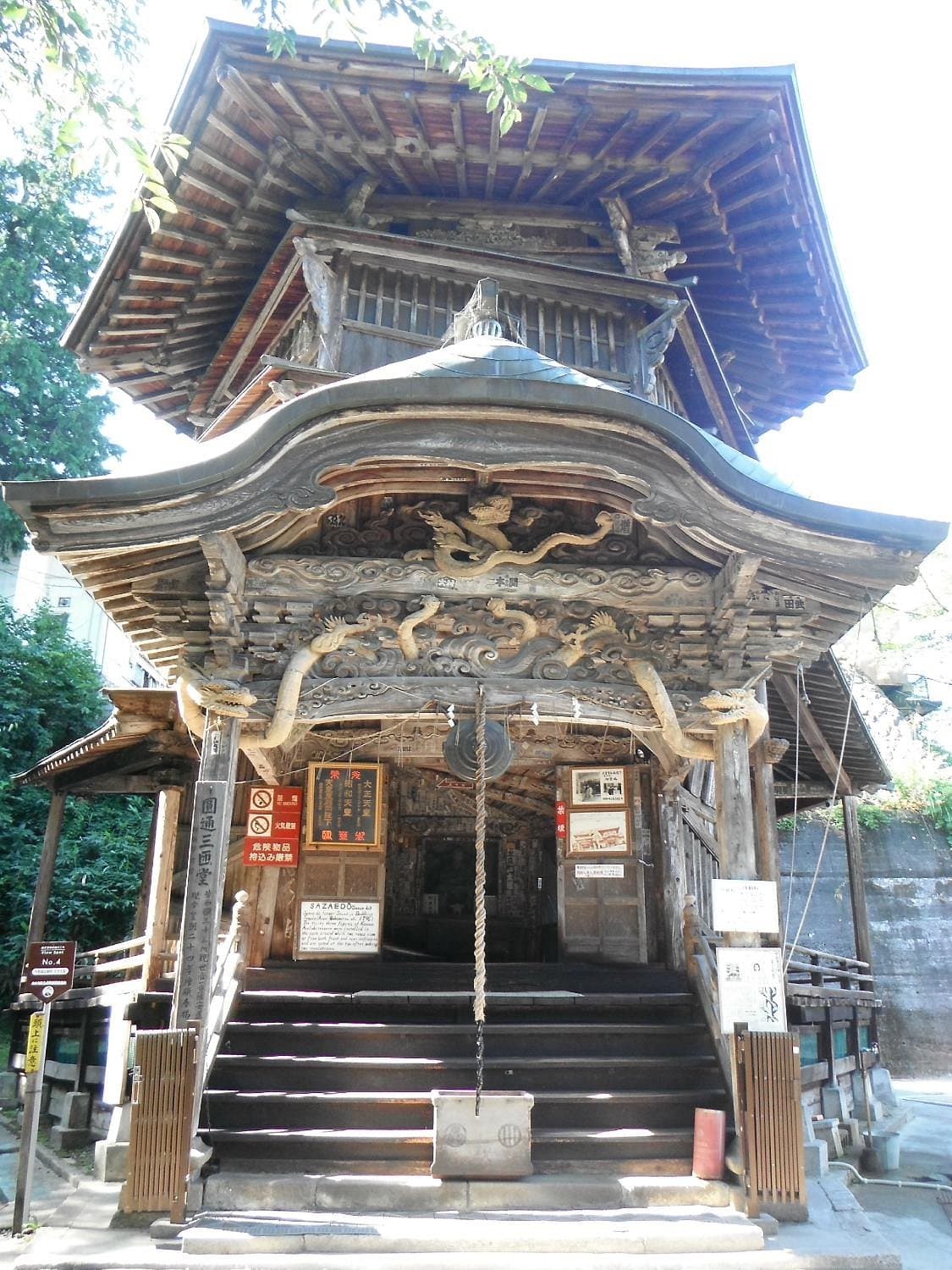
Sazaedo, also known as the Sazae-do Temple, is an extraordinary three-story hexagonal wooden temple built in 1796. It stands out globally for its unique double-helix ramp structure, which allows visitors to ascend and descend without ever crossing paths. This ingenious design, inspired by the spiral shell of a turban snail (sazae), was originally conceived to facilitate a smooth flow of pilgrims.
Visitors consistently praise the temple's architectural ingenuity and historical significance. Many describe it as "unusual," "interesting," and "magical," highlighting the wonder of its construction without modern tools. Reviewers often express awe at the complexity and detail achieved entirely by hand. While some find the interior simple, focusing on Kannon images rather than statues, the experience of navigating the one-way spiral is widely considered worth the modest entrance fee. The connection to the nearby Byakkotai memorial on Iimoriyama also adds to its historical context, making it a meaningful stop for those interested in Japanese history.
To make the most of your visit, allocate about 30-60 minutes to explore Sazaedo and its immediate surroundings. The best time to visit is during daylight hours, as the natural light enhances the experience inside. Wear comfortable shoes, as there's a steep ramp inside and some stairs leading up to the temple. While the view from the top isn't the primary draw, the unique internal structure is the main attraction. Several visitors recommend combining a visit to Sazaedo with the Byakkotai gravesite and other memorials on Iimoriyama.
Sazaedo is located on Iimoriyama, a small hill in Aizuwakamatsu. It's about 3.5 km from the city center. Many visitors arrive by the Aizu Loop Bus, which drops off at the foot of the hill. From there, it's a walk up, which includes some stairs, but an escalator is also available for convenience. For those driving, there's a municipal parking lot down the hill, often free to use, though finding a spot can sometimes be challenging. The walk from the parking lot to the temple is manageable.
A common point of discussion among visitors is the perceived value of the entrance fee versus the interior's simplicity. Some reviewers, expecting numerous statues, found the interior primarily adorned with pictures of Kannon. To mitigate potential disappointment, it's helpful to understand that the primary draw is the architectural design itself, not an elaborate display of artifacts. Focus on appreciating the historical engineering marvel rather than expecting a traditional temple interior filled with ornate religious objects.

